
Nameless
THE SEVEN CYCLES OF PEACE
Author’s Note – I shared way back when that I've been (still very slowly) working on a project inspired by the Yoruba pantheon and creating vignettes to help with my world-building. Here's another one of those! If you missed the first one, The First Journey, click here.
She was born gazing up into her parents’ eyes. The first time, those eyes were brimming with pure, unbridled joy. The second time, renewed joy tempered with relief and a touch of fear. By the third time, fear and wariness had cast long shadows over that joy. The fourth time, their eyes had become deep wells, where anticipated loss mingled with faint glimmers of hope. The fifth time, their eyes were dark tunnels of endless despair. Now, in this sixth moment, she interpreted their silent plea for this to be the last time.
In case it wasn’t clear, she was an abiku, a spirit child caught in an endless cycle of death and rebirth. Abiku were varied—some were crazily frenzied, others ominously malicious, a few giddily spiteful, and some morosely dark. Yet, all shared the same cruel goal—to shatter the hearts of as many parents in as many lifetimes as they could.
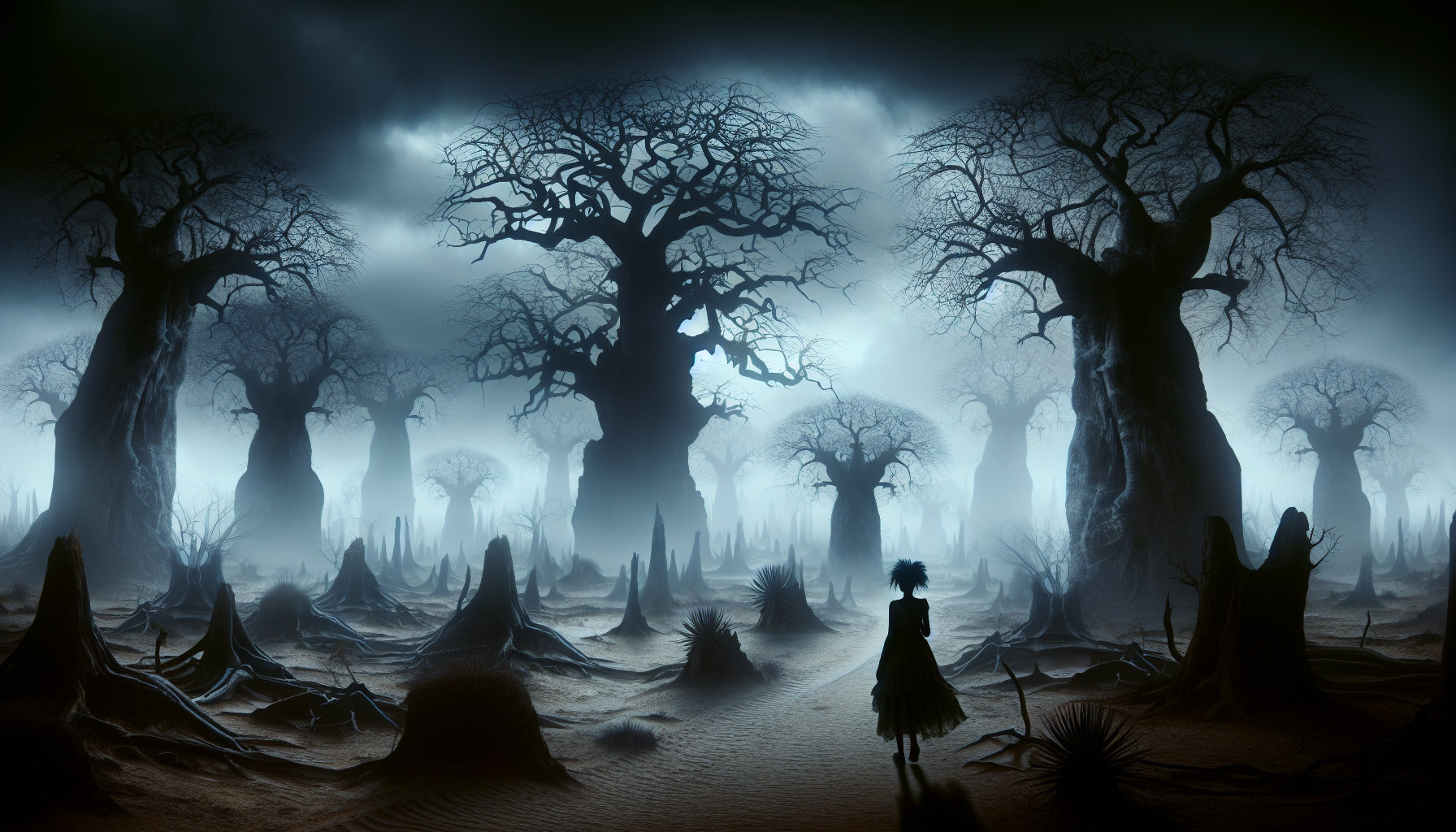
She was an anomaly among her kind—undead children—the abiku who longed to stay. She couldn’t quite grasp why, but each time she returned from the world of the living to the shadowy realms beyond, a dissonance echoed within her. It was as if she were a misplaced chord in an otherwise perfect symphony. Here, where foreboding iroko and spectral baobab trees loomed overhead, their twisted branches reaching out like gnarled fingers against the darkening sky, where towering anthills cast long, sinister shadows across the barren earth, where not even a blade of grass dared to grow, she felt like she didn’t belong.
The triumphant return from a cycle, especially the first, was a much heralded spectacle among the legion. As scores of abikus returned with calabashes shimmering with tears, choruses of screeches and cackles would fill the air, bouncing off the ancient trees. A thick, palpable tension would hang in the air as one by one, the returning abiku presented their calabashes to be inspected and judged with a critical eye.
The fuller the calabash was with weeping, wailing, and gnashing of teeth, the greater the acclaim bestowed upon its bearer. And so, the undead children would jostle and push, their spectral forms swirling around one another in a manic dance of anticipation as they waited to see who had wreaked the most torment and thus collected the most tears from their birth parents in their calabash.
One mother had thrown herself into the river, never to be seen or heard from again, after Ariori had cycled through her life multiple times until she could no longer have children. Rumor had it that Ariori had taunted her all the way to the riverbank, crowing in delight at the splash as she fell.
Another mother, like many others, had been driven stark raving mad after the eleven cycles of Jokotimi. She haunted the marketplace day and night, calling out the eleven different names she had gifted the changeling.
Ekunsunmi held the record among the abiku. Each time, she stretched her stay to the brink of puberty—the maximum length of time permissible for abiku—and chose the most heart-wrenching moments to return. It was rumored that in her last cycle, she had calmly sat for breakfast with her parents, picked up her spoon, and then collapsed with a smile on her face, lifeless, onto the dining table. She returned with the heaviest calabash ever seen.
Reaching the record meant graduating into the emere assembly. This prestigious group could linger beyond puberty, becoming permanent sources of misfortune in their assigned homes. They could also come and go as they wished. Additionally, they claimed their own iroko tree, around which they could gather their own flock of abiku. This was the ultimate dream for every abiku.
Not her, though; none of this appealed to her. She had gone complacently enough on her first cycle, emerging from the dark into the light of the world of the living to be greeted by two smiling faces. She felt nothing beyond a mild curiosity and a peculiar pull, accompanied by a murmuring that lingered in the background and never left. They called her Faith then.
The return from that first cycle was equally uneventful. She was playing with her toys when Nanny announced it was time for lunch. She threw a tantrum, not wanting playtime to be over and Nanny smacked her bottom. Then, she felt it—a shimmering in the air—and there they were, her cohort.
"It's time to go," Kasimawo said, extending his hand. E je ka lo.
Kasimawo took his role as the abiku leader of their cohort seriously. He was the same in his cycles—he entered solemnly and returned the same way, eschewing the theatrics he believed to be beneath their community’s dignity.
She had waited to feel the longing for home that she was told would come, the yearning for the lands beyond that would linger until the cycle ended. But nothing came—only the strange pull with the same subtle intensity. Still, it was her duty, so she took his hand.
Her body suddenly went limp and cold in Nanny’s arms. Nanny’s screams rented the air. Ki l'o s’omo yii? E ma gba mi! E gba mi oooo!
She watched dispassionately as her mother, grandmother, and father rushed in, their faces twisted in panic as they tried to revive her lifeless body. As she watched their useless attempts, an ache spread across her chest, like a thousand bees stinging her from the inside. Later, she would know this as heartbreak. But not then. Then, she didn’t understand it; she just knew she could no longer bear to watch.
She had turned away, unable to revel in her first conquest. She took Kasimawo’s hand, linked to Durosinmi’s, then Ajitoni’s, and others. She blinked awake into the dark lands beyond, her nostrils stinging at the acrid aroma of burning wood mingling with the scent of decay that she had forgotten.
The pull and the murmuring were gone but her insides still felt like they had been stung by bees. She looked bemusedly at her calabash of tears—clear and golden. The emere leader of her cohort praised their premium quality effusively while Atitankoyi glared in annoyance. She had expected to feel pride but there was only a faint sense of ennui. She knew she didn’t want to do it again, yet…
The second time was just as bewildering and draining. Her return from the cycle as the daughter named Hope was met with no fanfare from the cohorts. Escorts were only granted on the first cycle; afterward, you were expected to find your own way home. From a distance, the uncanny croon of a raven reached her ears and she felt herself swooning to the ground, amid the shouts of her playmates by the playground slide. Another pat on the back for a job well done. Another calabash filled with precious tears.
“Has there ever been an abiku who never returned?” She once asked Atitankoyi, the one in her cohort who seemed to know everything about everything.
His eyes, constantly sparkling with spite, held a glint of derision as they lingered over her face. “Never returned from where?”
“From…you know…” She stopped, unsure how to continue the conversation without revealing too much.
“You mean, an abiku who wanted to stay?” He replied, his lips curled as he laced each word with scorn. “Why would anyone want to stay?”
She shrugged, her heart pounding in her chest like a drumbeat as he stared at her fixedly as if trying to read her mind. Then he said, his words dripping with venom, “Eniayewu tried.”
She bit her lip, refraining from asking how Eniayewu managed it, but he continued anyway, recounting Eniayewu’s fate in glee. “She’s a mere shadow of herself in the land of the living—unloved by her husband and rejected by her family because she gave birth to an emere.”
He dismissed her with a knowing look and a languid wave of his hand. “Abiku must always return. If they don’t, we will torture them for the rest of their days.”
She silently acknowledged his veiled threat with a jerky nod.
Still, by her third cycle as the daughter named Patience, she found herself grappling with a weariness that ran deep. Each return to the lands of the dead left her feeling more hollow than before, starved for a sense of belonging she could not find among the shadowy trees and crooked pathways. In contrast to her fellow abiku who thrived on the anguish they wrought upon their birth parents, she found herself untouched by her own parents’ suffering. While her peers fed fat on the torment they extracted, her soul remained gaunt and hungry.
As she lay dying in her grandmother’s arms, consumed by an unexplained fever that had sprung up overnight without warning, she whispered a longing to be free, a plea for release from the suffocating weight of tears that was her duty to cultivate as an abiku. Maami, e so fun Mama ati Baba pe ki won ma ke mo. E ma ke, e jo.
Maami must have understood her obscure plea, for upon her return, her calabash had been next to empty. No treasures to fill the coffers this time, just more bee stings within. She stood in silence as the cohorts taunted her. Your run is over! Time to find another well! They don’t love you anymore! Their words stung, but not as sharply as the bee stings.
By her fourth cycle, desperation drove her to try her luck with premonition. One day, during a visit from Maami, the six-year-old granddaughter named Endurance curled up in her grandmother's soft arms.
Maami, she said softly, nestled in the comforting embrace unavailable to her in the shadowy realms. Mo ti fe ma lo. Awon egbe mi n duro de mi.
Maami’s brows furrowed in concern, sensing an odd, underlying urgency in her granddaughter's words. Ehn? Ki l'o wi?
She repeated the subtle warning about her imminent departure. The cryptic words had Maami hurrying the next day to consult with Baba Adeoti, an enigmatic elder in their neighborhood. The brass rings on her ankles and the iron aro bracelets on her wrists he suggested didn’t prevent her return from the fourth cycle a year later. Nor did the scars he etched with a blade in her skin during the fifth—she merely reemerged in her sixth cycle with ghastly, jagged marks that made her parents recoil in horror.
Now she sat resigned, gloomily watching cohorts of abiku chasing each other with deafening screechs, her shoulders sagging under the weight of their racous laughter. She toyed absently with the hem of her white wrapper, dreading the start of her seventh cycle in mere hours. She blinked slowly then startled as a figure emerged out of the shadows nearby. It was Yewa, the elusive goddess of night and nightmares, observing the abiku and emere at play with an inscrutable expression.
Little was known about Yewa, except that she had once been the goddess of purity and following a scandalous affair with Sango (of all the gods!), had been exiled by her father, Obatala, upon his discovery of the affair and Yewa’s handling of its aftermath.
Yewa seemed to have accepted her role as the keeper of the lands of silence with a quiet but profound resentment that wrapped itself around her very being, revealing itself when any of the denizens of the lands beyond dared to interact with her. Despite her responsibility for overseeing the egbes, she rarely intervened. She accepted the newly arrived young souls conveyed by Oba, the porter of the souls, and granted passage through the gates of the dead under the watchful eye of Oya, the guardian of the gates, only to hand them right over to the emeres for allocation to the appropriate cohort. That was the extent of her involvement with them.
Casting a wary glance at Yewa, she wondered how she filled her days—there were rumors that she devoted her time to coaxing growth in a land that could bear no fruit. Such absurdity. Yet, she pondered casually if Yewa could be of help. After all, she held the secrets of the dead from the living.
With that thought in mind, she somehow found the courage to inch closer until she stood next to Yewa, her knees knocking together. For several tense moments, they stood side by side, no words exchanged between them.
Finally, Yewa exhaled in slight annoyance and her question cut through the silence like a sharpened blade. Ki l'o fe?
She sucked in a surprised breath at Yewa’s direct demand to know what she wanted.
“My next cycle begins tonight, but I want to stay,” she whispered timidly. Stay. Stay. Stay. As a sudden, harsh wind whipped her barely audible words away in echoes, she wondered who had roused Oya’s temper this time.
Yewa’s contemplative gaze drifted towards the gates of the realm as she seemed to weigh her ask. The air around them seemed to thicken, carrying the ethereal scent of decaying leaves and stirring the hairs on her neck.
“Stay? Here?” Yewa’s tone carried a note of incredulity. “Have you completed so many cycles already?”
“No, not here,” she hastily clarified, her words spilling forth in an urgent torrent of emotion. “I want to stay there. I want to leave and not…return…here.”
A flicker of surprise danced across Yewa's usually stoic face, the slight shift in her demeanor a testament to the gravity of the request.
“Ah, I see,” Yewa said carefully. “Why?”
She stared at Yewa, words stuck in her throat like stubborn pebbles. How could she begin to explain that she never felt at home here? How could she put into words the exhaustion from cycling back and forth with no respite? How could she describe the sensation of the stones that sat heavy in her chest whenever she thought about her mother’s eyes, hazy with uncountable tears, and her father’s face, chiseled with unassailable grief?
Words failed her, so she simply stared at Yewa, who was still scrutinizing her with an unblinking gaze. It was unsettling; you could never decipher Yewa’s thoughts.
After what seemed like an eternity, Yewa turned her attention back to the screeching abikus, saying nothing. After another long, excruciating pause, her knees trembling even more, she pushed past the churning in her belly and asked, “Yeye Awa, can you please help me? Please?”
Yewa sighed heavily. “I’ve always wondered why they called your kind abiku. After all, all men are born to die. But you, your kind, have the power to choose the time to die, time and time and time again. Power such as men would kill to have, to know the hour of their death even but once? Such power — and you would give it away?”
Her throat tightened with a knot as she thought about her mother’s smile—that special one that lit up her round face whenever she looked at her daughter. That smile felt like being bathed in the light of a thousand suns. Oh, how she missed the sun—the sun never shone in the lands of silence. Only the moon with her cold and chilly visage, akin to Yewa herself, ruled. Would she give such power away?
“For the love of my mother, yes,” She replied fervently, earning a bemused snort from Yewa. She wondered if she had said the wrong thing, knowing that Yewa, once the vanguard of purity, had never known her own mother. Not much was known by anyone about the goddess who was both Obatala’s wife…and sister, and why she had chosen eternal sleep.
“Love,” Yewa softly intoned, her voice tinged with a note of melancholy, as though love were the fleeting answer to a question she could no longer remember, a question long forgotten. “Love.”
With a sharp pivot, Yewa faced her. Her features had become sharper, the whites of her eyes now abyssal voids, shadows pulsing beneath her dusky skin. Her curls undulated wildly in the wind Oya had stirred up earlier that showed no signs of calming. The earth beneath her feet seemed even more parched than the surrounding dry land.
She gasped. The rumors were true, then. Elegbara had surrendered the reins of the Ajogun to the queen of nightmares. She had been absent on one of her cycles during the rumored exchange, and since nothing seemed different upon her return, she discounted its importance. But this was not the quiet keeper of the lands of silence standing before her; no, this was the preying owl, ready to swoop and strike with a lethal precision.
Only belatedly did she notice that she and Yewa had acquired an audience. She clenched and unclenched her fists at her sides as she took in her cohort and others, who had gathered, draped in their customary white attire, their eyes gleaming with curious malice.
Ki l'o fe? Yewa demanded, just as she had at the start, her voice harsh and grating. What do you want? Shadows rose and flickered, swirling around her form. She thought she heard Elegbara’s infamous mocking laughter trailing behind but that couldn’t be possible, could it?
Her breath came in short, frightened pants as she stuttered. Mo fe pada.
Yewa laughed. Se o tan?
At Yewa’s request to know if that was all, she felt emboldened. Mi o fe lo mo.
An agitated murmuring arose from the group of immaterial children gathered around them.
Another amused laugh. Se o tan n'isin yi?
Glancing nervously at the cohorts, she tacked on a final, earnest appeal. Mo fe duro.
Shocked gasps erupted from the assembly.
Unlike her, Yewa ignored the commotion. O ya, wo mi.
She perversely screwed her eyes shut at Yewa’s command to look at her, now thoroughly afraid of where this was leading. What had possessed her to make this bold supplication to the unknown, unpredictable goddess?
Wo mi. Yewa’s tone brooked no dispute.
So she cautiously opened one eye, and then the other, and peered at Yewa, who appeared different, cloaked in an otherworldly aura of malevolence.
The abiku who stays must be uprooted from the soil of the dead and grounded in the soil of the living. If you reach the gates, smash your calabash to uproot yourself from these lands. If you make it home, your mother must plant white lotuses to ground you in those lands. She sensed rather than heard the unspoken words.
With her head spinning from these revelations, she thought quickly. The first task seemed manageable—she only had to outrun the outrightly hostile cohorts who lingered, growing angrier with every passing moment, enraged by her betrayal of everything they stood for. But the second task posed a challenge. How would Mama know to…?
“I will haunt her in her dreams.” Yewa declared the chilling promise aloud this time. “If your mother loves you as much as you love her, she will dance to the tune of my nightmares."
Yewa's head tilted, a silent behest in her gesture. "Now, you deviant changeling, run."
And so, she did. She dashed unexpectedly towards the gates demarcating the boundary between the realms, moving with a speed that caught the unprepared abikus off guard. The dark path ahead stretched out like an ominous highway, its twists and turns shrouded by the cover of night. Behind her, the enraged horde of cohorts pursued with unrelenting fury, their screams of anger setting off startled squawks from disturbed ravens and crows, a cacophony that reverberated through the air like a harbinger of impending doom.
As she reached the gates, someone grabbed her shoulder. Atitankoyi, his face serpentine with an unholy anticipation as he clamped down with a grip that felt like an iron bar. He sneered triumphantly as he began to drag her back into the clutches of her vengeful pursuers.
Desperate and frantic, she reached for her calabash, her fingers closing around its smooth surface with a grim determination. With a primal scream of defiance, she swung the vessel with all her strength and smashed it fiercely against his face, the sickening thud echoing through the night like a thunderclap.
Stunned by the blow and nearly blinded by the shards flying through the air, Atitankoyi recoiled with a earsplitting howl of pain, stumbling backward into the throng of cohorts that surrounded him. She seized the chance to break free from his grasp, pushing past the mother of all bee stings, a sudden, tearing pain where her heart should have been. With the last of her strength, she propelled herself through the gates, just as everything faded to black. A new cycle had begun.
On her seventh cycle, she opened her eyes to find two pairs of tear-stained eyes gazing down at her. Mama had been tormented throughout this pregnancy with dark dreams prominently featuring white lotuses, and an indescribable instinct had prompted her to have her husband plant them in their backyard garden, shielded from prying eyes. The soil had been watered almost daily with Baba's sweat and Mama’s tears.
She closed her eyes for a moment. No inexplicable pull. No distant murmurs in the background. No bee stings. She had done it.
She had returned. Mo ti pada.
She was staying. Mi o lo mo.
She was rooted. Mo ma duro.
This time, they called her Peace. Peace, be still.
© Lara Brown, 2024
Photo generated by AI - reposting here because the full photo is too good to not be shared!
